2026 Best UVC Sterilization Equipment for Buyers?

Uvc Sterilization is moving from specialist laboratories into hospitals, food facilities, schools, and commercial buildings. Buyers now face a crowded market, with cabinets, air-cleaning units, conveyor systems, and surface devices claiming fast microbial control. The choice is not simple. A bright lamp does not automatically mean effective disinfection.

The World Health Organization reports that 2.2 billion people still lacked safely managed drinking water in 2022, keeping reliable disinfection technologies highly relevant. Meanwhile, the U.S. Environmental Protection Agency explains that ultraviolet performance depends on dose, exposure time, microorganism type, lamp condition, and surface distance. These details matter beside a stainless-steel chamber, where shadows or dust can leave untreated areas. The U.S. CDC also recognizes germicidal ultraviolet irradiation as a useful supplemental approach for reducing airborne pathogens, when properly designed and maintained.

Dr. David J. Brenner, director of Columbia University’s Center for Radiological Research, said, “Far-UVC light has the potential to be a safe and effective way to prevent the spread of airborne-mediated diseases.” His statement supports careful optimism, not blind purchasing. Safety controls remain essential, including shielding, interlocks, verified dose, and documented maintenance. Some product claims still sound stronger than their published evidence. That deserves scrutiny.

This 2026 buyer’s guide compares Uvc Sterilization equipment through measurable performance, operating environment, safety design, validation documents, and total ownership cost. Expect practical questions. Is the rated dose independently tested? Can operators see lamp-life alerts? Does the equipment protect staff during routine loading? The best answer may not be the most powerful machine. It may be the one that performs consistently, visibly, and safely.

2026 Best UVC Sterilization Equipment for Buyers?

Define UVC: 200–280 nm wavelengths and germicidal dose in mJ/cm²

When evaluating UVC sterilization equipment in 2026, start with the wavelength, not the product label. UVC refers to ultraviolet light from 200 to 280 nanometers. This range can damage the DNA or RNA of many microorganisms and prevent reproduction. Performance depends on wavelength, exposure time, distance, and surface conditions.

Germicidal dose is measured in millijoules per square centimeter, written as mJ/cm². Dose equals irradiance multiplied by exposure time. A device delivering 2 mW/cm² for 10 seconds provides 20 mJ/cm². That figure must reach the target surface, not merely the lamp output.

Distance matters greatly. So do shadows. Dust, rough materials, airflow, and lamp aging can reduce the delivered dose.

For purchasing decisions, request dose maps and test conditions. Ask where measurements were taken and which microorganism was tested. A calibrated UVC radiometer can verify output during commissioning and maintenance.

Do not rely on wattage alone. It describes electrical consumption, not germicidal delivery.

A common mistake is assuming one dose works everywhere. It does not. Air treatment, water treatment, and surface disinfection require different designs.

I have seen clean-looking chambers perform poorly because internal corners received little UVC exposure. The equipment may appear powerful. The dose may still be insufficient.

Treat “sterilization” claims carefully. True sterilization requires validated procedures and defined microbial reduction targets.

Select systems with accessible measurement points, safety interlocks, replacement guidance, and documented performance. Recheck them after installation, because real conditions rarely match the laboratory perfectly.

Compare 254 nm lamps, 265 nm LEDs, and excimer UVC sources

For 2026 buyers, wavelength should guide the equipment choice, not marketing claims.

A 254 nm lamp remains practical for water, air, and exposed surfaces. It usually delivers strong germicidal output at a reasonable purchase cost.

However, lamps contain fragile glass, need warm-up time, and lose intensity as they age. Cold rooms can also reduce performance. A calibrated radiometer is essential.

A 265 nm LED offers a compact alternative. LEDs start instantly, support frequent switching, and allow flexible reactor designs.

Their output can be directed into narrow treatment zones, such as ducts or small chambers. Yet efficiency, heat removal, and optical design still limit many systems.

A bright-looking LED is not automatically powerful. Buyers should request measured irradiance, operating temperature, and expected lifetime data.

Excimer UVC sources can produce shorter wavelengths, including filtered far-UVC options near 222 nm.

These sources may reduce penetration into living tissue, but safety depends on spectral filtering, exposure limits, and installation controls.

They can suit occupied environments only when independent testing supports the design. Ozone formation also requires attention, depending on the emitted spectrum.

I would not compare these sources by wavelength alone.

Dose, distance, airflow, shadowing, and surface texture often decide the real result. That part is easy to underestimate.

A careful buyer should test performance on-site, record readings, and plan lamp or module replacement before output becomes unreliable.

Verify output with ISO 15858, IEC 62471, and third-party dose testing

The 2026 best UVC sterilization equipment should be judged by verified dose, not lamp power or marketing claims.

ISO 15858:2016 requires clear safety information for UVC devices, including exposure risks and protective controls. IEC 62471 adds photobiological safety assessment for lamps and lamp systems. These standards matter when equipment operates near workers.

Ask for a third-party test report using calibrated radiometers. The report should show irradiance, exposure time, distance, airflow, and delivered dose in mJ/cm².

ASHRAE Handbook—HVAC Applications (2023) identifies these variables as core factors in UVGI performance. A chamber reading is not enough. Real installations contain shadows, dust, uneven airflow, and aging emitters. Small details matter.

Check the weakest measured point, not the brightest one. Request testing after warm-up and under normal operating conditions. Include maintenance records and sensor calibration dates.

CDC environmental infection-control guidance describes UVGI as a supplement to ventilation, not a replacement. That distinction is often missed.

I would also question reports using only nominal wattage. It sounds technical, but it proves little. A buyer should compare independent dose maps, safety test results, and measured output decline over time.

Some testing plans remain incomplete, especially when airflow changes after installation. That deserves a second review before purchase.

Match air, water, and surface systems to NSF/ANSI 55 and ASHRAE 241

Choosing the best UVC sterilization equipment in 2026 starts with the treated medium. Air, water, and surfaces need different performance evidence. They should not be judged by lamp power alone.

For drinking or process water, check certification against NSF/ANSI 55. Class A systems target contaminated water, while Class B systems support supplemental treatment in already potable supplies. Ask for validated flow rates, UV dose data, sensor accuracy, and maintenance records. A clear quartz sleeve matters. So does a clean one. Turbid water can reduce performance, even when the equipment appears fully operational.

Air systems require a wider design view. ASHRAE 241 evaluates infection risk management through equivalent clean airflow, not one device in isolation. UVC fixtures may contribute to that airflow target, alongside filtration, ventilation, and occupancy controls. Confirm irradiance, room geometry, shielding, interlocks, and exposure limits. Surface systems need separate evidence for coverage, shadowing, contact time, and material compatibility. A glossy tabletop is not a hospital curtain. Results can differ sharply. Avoid treating a laboratory claim as a field guarantee. Commissioning, periodic measurement, and honest review of failures are essential, although buyers sometimes underfund these steps. That is a mistake worth revisiting.

2026 Best UVC Sterilization Equipment for Buyers

Match air, water, and surface systems to NSF/ANSI 55 and ASHRAE 241 requirements.

NSF/ANSI 55 defines ultraviolet treatment performance for drinking-water systems: Class A systems are validated at a minimum UV dose of 40 mJ/cm², while Class B systems are designed for supplemental treatment at 16 mJ/cm². ASHRAE 241 addresses infection-risk management for indoor air through equivalent clean airflow and does not prescribe one universal UVC dose. Surface systems should be selected and validated according to target microorganisms, exposure time, shadowing, and measured irradiance.

Rank 2026 equipment by irradiance, rated life, safety, and total cost

For 2026 buyers, equipment should be ranked by measured performance, not lamp wattage. Irradiance at the target surface matters most. A calibrated radiometer should verify readings at several distances and angles. Dose equals irradiance multiplied by exposure time. Small shadows can leave untreated zones. This is often missed.

Rated life deserves careful interpretation. A lamp may remain lit while its UVC output declines. Ask for end-of-life irradiance data, replacement intervals, and performance records. Solid-state emitters may offer different aging patterns, but heat management still affects output. Keep evidence. Marketing tables are not enough. I would also compare warm-up time, duty cycles, and cleaning access. A cheaper unit can become expensive when filters, lamps, labor, and downtime accumulate.

Safety is non-negotiable. Look for enclosed treatment chambers, door interlocks, emergency stops, status indicators, and fault logging. Room systems need occupancy detection and controlled access. UVC can injure eyes and skin within seconds; visible light is not a reliable warning. Evaluate total cost over five years, including validation, calibration, energy, disposal, and training. The lowest calculated cost may hide weak monitoring. I would leave room for doubt, because real rooms contain dust, reflective surfaces, and human mistakes. Ask for independent test methods and repeat measurements after installation.

2026 Best UVC Sterilization Equipment for Buyers — Ranked by Irradiance, Rated Life, Safety, and Total Cost
Rank Equipment Type Typical Primary Use Representative UVC Source Typical UVC Irradiance or Dose Rated Lamp Life Safety Level Typical Capacity or Coverage Typical Power Demand Estimated 5-Year Total Cost of Ownership Buyer Score Best Buying Advantage
1 Enclosed UVC Air-Disinfection Unit Occupied rooms, classrooms, clinics, offices, and waiting areas Low-pressure mercury or amalgam UVC lamps, commonly centered near 253.7 nm 2–8 mW/cm² inside the shielded chamber; effective room dose depends on airflow and residence time 9,000–12,000 hours High when the housing is interlocked, fully enclosed, and leak-tested Approximately 250–1,200 m³/h per unit 80–350 W US$3,000–10,000 89/100 Strong balance of safety, continuous operation, predictable maintenance, and moderate installed cost
2 In-Duct UVC HVAC System Air treatment inside supply ducts, return ducts, coils, and air-handling units High-output low-pressure or amalgam UVC lamps 1,000–3,000 µW/cm² at the treated coil or target surface; engineering verification is required 9,000–16,000 hours High when installed inside sealed ductwork with access-door interlocks Approximately 2,000–50,000 m³/h, depending on air-handler size 150–1,500 W US$7,000–20,000 87/100 Efficient for centralized buildings and useful for coil surface control and continuous air treatment
3 Upper-Room UVGI System Large occupied spaces with high ceilings and continuous airborne infection-control needs Shielded low-pressure UVC fixtures, usually near 253.7 nm Typically 150–400 µW/cm² in the upper-room treatment zone; lower levels must remain below exposure limits 8,000–12,000 hours Medium to high when professionally designed, measured, and commissioned Approximately 50–150 m² per fixture, subject to ceiling height and ventilation 30–150 W per fixture US$4,500–12,000 84/100 Low energy use and good scalability for high-occupancy rooms when exposure control is carefully managed
4 Point-of-Use UVC Water Reactor Drinking water, process water, wastewater polishing, and microbial reduction in clear liquids Low-pressure mercury, amalgam, or UVC LED reactor modules Typical validated UV dose: 30–60 mJ/cm²; actual dose depends on flow, UV transmittance, and lamp output 9,000–16,000 hours for lamps; UVC LEDs commonly use an output-maintenance rating High because UVC is contained within the reactor body Approximately 1–100 m³/h for common commercial systems 40–1,200 W US$4,000–18,000 82/100 Highly measurable treatment performance when flow rate, UV transmittance, and delivered dose are monitored
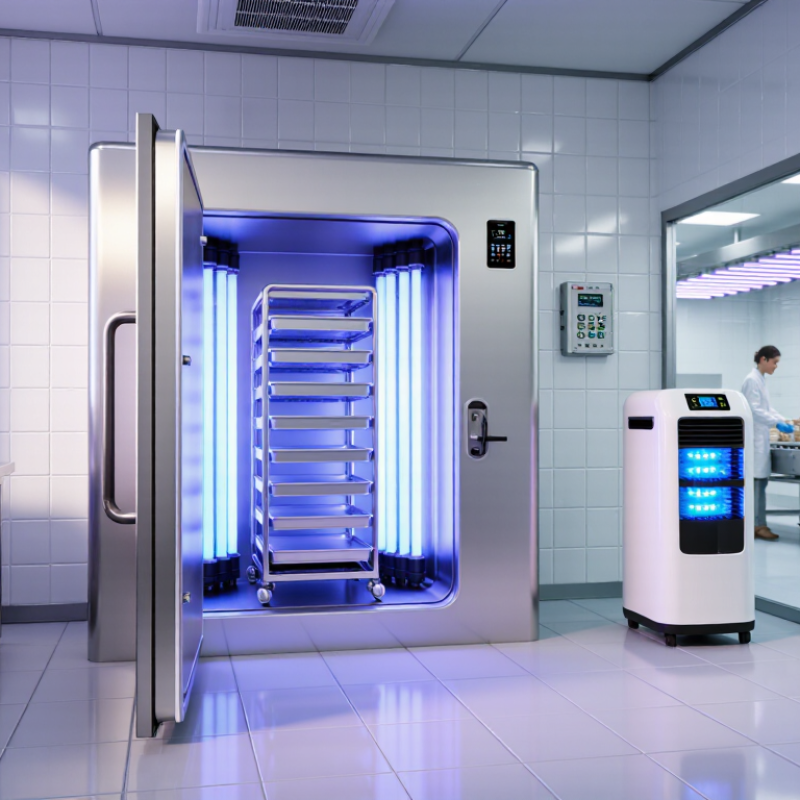
5 UVC Sterilization Cabinet or Chamber Small tools, laboratory items, personal equipment, packaging, and exposed surfaces Low-pressure UVC lamps or UVC LED arrays 2–10 mW/cm² at exposed surfaces; shadowing and surface distance strongly affect delivered dose 9,000–20,000 hours, depending on source type High when equipped with door interlocks, opaque walls, and automatic cycle controls Approximately 0.05–2 m³ chamber volume 40–500 W US$4,000–18,000 79/100 Compact, repeatable, and comparatively easy to validate for small loads with clear line-of-sight exposure
6 Autonomous UVC Surface-Disinfection Robot Unoccupied patient rooms, operating areas, laboratories, transport vehicles, and high-touch surfaces Multiple low-pressure UVC lamps or high-power UVC LED modules Approximately 1–3 mW/cm² at 1 m for many systems; delivered dose depends on distance, dwell time, and shadowing 6,000–12,000 hours High only when motion sensors, occupancy detection, emergency stop, and access controls are functional Approximately 20–100 m² per automated cycle 300–1,500 W during active treatment US$25,000–80,000 75/100 Automates large-area surface cycles and records treatment history, but has the highest capital and validation cost
Buyer data note: Values are representative 2026 planning ranges for commercially common UVC equipment configurations, not manufacturer-specific specifications. Irradiance values are not directly interchangeable across air, water, and surface applications; final selection should use a validated delivered dose, measured UV-C output, airflow or flow rate, exposure distance, and applicable occupational safety limits. Five-year total cost estimates include typical purchase, installation, replacement components, electricity, and routine maintenance, but exclude major building modifications and labor-rate differences.