How to Choose LED Acrylic Letters in 2026
Choosing Led Acrylic Letters in 2026 means balancing visibility, appearance, energy use, and maintenance—not just comparing prices. Grand View Research estimated the global LED lighting market at about US$75.3 billion in 2023 and projected continued growth through 2030. That market forecast signals expanding adoption, but it does not tell you which sign will suit your storefront. Specifications still matter.
The U.S. Department of Energy’s Energy Saver guidance says LEDs use at least 75% less energy and can last up to 25 times longer than incandescent lighting. Treat those figures as a general comparison, not a promise about a finished sign. Letter depth, LED quality, heat management, installation conditions, and operating hours can all affect real-world performance. Small details count.
Start with the viewing distance and the wall behind the sign. A narrow serif may look elegant up close, yet disappear across a busy lobby. Ask for the acrylic face color, return depth, LED color temperature, dimming options, and access for servicing. Check how wiring and power supplies will be reached after installation. That part is easy to overlook.
A reliable comparison uses written specifications, clear warranty terms, and photos of completed projects in similar settings. Ask what the warranty excludes. It may reveal more than a glossy sample. Forecasts offer useful context, but they cannot replace a sample viewed under your actual lighting. This guide explains how to assess materials, illumination, construction, and supplier claims before choosing letters for your space.
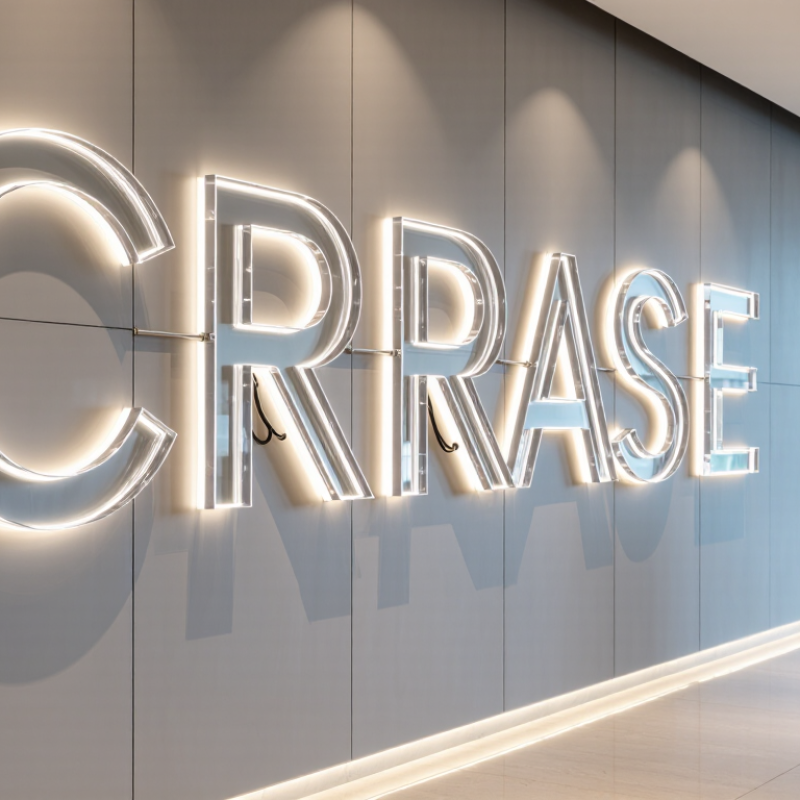
Define LED Acrylic Letters: PMMA Can Transmit Up to 92% of Visible Light
PMMA, commonly called acrylic, is the clear face material used on many illuminated letters. Some grades can transmit up to 92% of visible light under specified test conditions. That figure is not a guarantee for every sign. Sheet thickness, tint, surface finish, and light wavelength can all affect transmission. Small details matter.
For a storefront sign, a high-transmission face can help LEDs appear bright and even, with less light lost through the panel. But the brightest face is not automatically the best choice. A clear sheet may reveal individual LED points, especially when the LEDs sit close behind it. Diffused or opal acrylic can soften those spots, though it may reduce apparent brightness. Test a sample with the intended LED color and spacing before approving a full set of letters.
Check the acrylic’s thickness and edge quality, too. Roughly cut edges can scatter light, while uneven bonding may create visible shadows around strokes and corners. Ask for the material grade and transmission data, and confirm whether figures refer to a specific thickness. In daylight, color and contrast matter as much as nighttime glow.
One thing is easy to overlook: dust inside a sealed letter can show up later as a dull patch. Even a careful design can miss something. The final appearance depends on the face, LEDs, housing depth, and installation conditions working together.
Compare Face-Lit, Halo-Lit, and Front-and-Back-Lit Designs
Face-lit acrylic letters send light through their front faces, creating bright, direct lettering that reads clearly from a distance. They suit storefronts and reception desks where quick visibility matters. Ask for an even LED layout: widely spaced modules can create bright spots, especially in thin letters. During the day, the face color and contrast matter as much as brightness.
Halo-lit letters cast light backward onto the wall, outlining each letter with a softer glow. The effect depends on the wall: a pale, smooth surface usually reflects light more evenly than dark brick or rough concrete. Leave enough space behind the letters for the glow to spread. Subtle, not silent. In a bright lobby, halo lighting can look unexpectedly faint—a detail a screen preview may not reveal.
Front-and-back-lit designs combine a glowing face with a rear halo, giving the sign strong visibility and a layered look after dark. They also add components and potential service points, so check how the LEDs and wiring can be accessed. For any option, consider viewing distance, ambient light, letter depth, and expected operating hours. There is no universal winner; a dramatic combination may feel crowded in a small space. Reviewing a full-size sample under the site’s actual lighting can prevent an expensive mismatch.
Choose Letter Size and Stroke Width for Viewing Distance and Readability
For LED acrylic letters, choose size by the distance where most viewers will first read the sign, not just by the wall space available. As a practical starting point, measure the viewing distance and test letter height on a printed layout or temporary mock-up. A sign across a parking lot needs taller letters than one beside a reception desk. Check the actual approach angle, too; people may see the sign from the side before facing it directly.
Tips: View a full-size sample from the farthest common viewing point. Check both daylight and evening conditions. If the text feels cramped, increase letter height or reduce the wording before narrowing the strokes.
Stroke width affects how quickly letters can be recognized. Thin strokes may disappear against bright surroundings, while overly thick strokes can close small openings in letters such as “e” or “a.” Acrylic edges and LED brightness also change the visual weight, so review a lit sample when possible. There is no perfect formula. I have seen careful measurements miss a nearby tree or an unexpected glare source, so inspect the site at eye level before approving production.
How to Choose LED Acrylic Letter Size and Stroke Width
Practical starting-point estimates for viewing distance and readability
As a rough planning rule, allow about 1 cm of letter height per 1.2 m of viewing distance. The stroke-width estimates are approximately 17% of letter height. These are starting points—not guarantees; check readability at the actual viewing distance, lighting, contrast, and installation location.
Evaluate LED Life with IES LM-80 and TM-21 Data
When choosing LED acrylic letters, ask for the exact LED package’s IES LM-80 test report, not a generic “50,000-hour life” claim. LM-80 records lumen maintenance over time under controlled temperatures and operating conditions. The standard calls for at least 6,000 hours of testing; longer records offer more useful evidence. Check that the tested drive current and temperature resemble the conditions inside your sign. A module sealed behind acrylic can run hotter than one on an open bench. Small details matter.
Then review the TM-21 calculation based on that LM-80 data. TM-21 projects lumen maintenance; it does not measure the sign’s actual service life. IES guidance limits how far test results can be projected, commonly to six times the measured duration, subject to the method’s rules. The U.S. Department of Energy’s report, LED Luminaire Lifetime: Recommendations for Testing and Reporting, also cautions that system components can fail before LEDs reach their projected lumen-maintenance endpoint. Ask for the report’s temperature, test hours, and projected L70 value, where L70 marks the point at which output reaches 70% of initial lumens. Compare the same metrics across suppliers. A neat number on a quotation is not enough. Even solid data cannot fully predict heat trapped in a particular letter cavity.
Check Outdoor Enclosures Against IEC 60529 IP Ratings
When choosing LED acrylic letters for outdoor use in 2026, check the enclosure’s IEC 60529 IP rating—not just the acrylic face. The first digit describes protection from solid objects and dust; the second describes protection from water. For example, IP65 means dust-tight and tested against water jets. It does not mean the letters can be submerged. Match the rating to the site: a sheltered entrance faces different exposure than a sign under driving rain.
Tips: Ask for the rating of the complete, assembled enclosure. Check that cable entries, seams, and service covers were included in the test configuration. A strong rating on one component may not protect the finished letters.
Read the test documentation, and confirm that the installation matches it. A loose gland or pinched gasket can undermine protection. I would also check UV resistance, temperature limits, and corrosion suitability separately; IP ratings do not cover those conditions. That distinction is easy to miss. A rating is useful evidence, but not a guarantee of long service outdoors. Even careful installations deserve periodic inspection, especially after maintenance or severe weather.
