
Garlic Powder Packets serve food-service operators, meal-kit brands, travel caterers, and retailers seeking consistent portions with minimal mess. Demand depends on more than garlic availability. Buyers also compare aroma, mesh size, ingredient composition, sachet weight, and packaging performance. FAOSTAT’s Crops and Livestock Products database records global garlic production at about 29 million tonnes in 2022. That figure describes the raw crop, not the supply of finished seasoning packets. The distinction matters. UN Comtrade trade data can help buyers examine garlic-related trade flows, but it cannot verify a supplier’s quality or production capacity.
This Top 10 supplier overview focuses on practical checks: product specifications, manufacturing experience, private-label options, sample availability, and export support. Codex’s General Standard for the Labelling of Prepackaged Foods (CXS 1-1985) offers a useful reference for reviewing package information, though buyers should confirm requirements in their target markets. Ask for current certificates, ingredient statements, and samples from the actual production line. Check whether each packet tears cleanly and keeps its powder dry. Small details count. A supplier can look strong on paper and still miss a buyer’s exact sachet needs. And supplier claims deserve scrutiny. No single ranking can replace a documented audit, clear specifications, and direct testing.
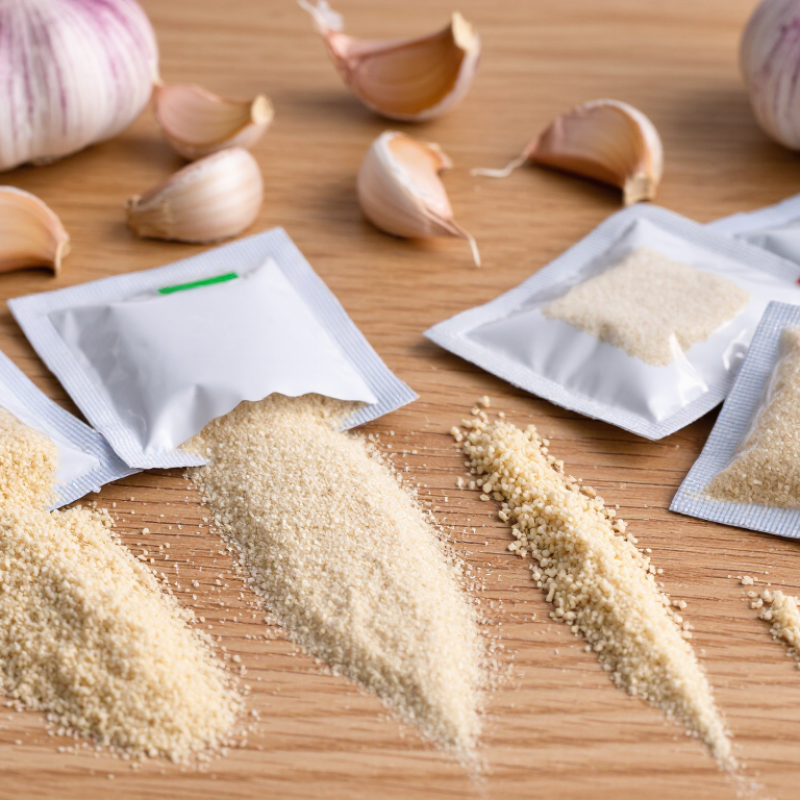
Garlic powder packets are available as flat sachets, pillow packs, and narrow stick packs. Each format affects filling speed, storage, and how easily a cook can empty the pack. Fine powder flows differently from coarser granules, so a supplier should confirm the product’s texture before finalizing packet dimensions. Small, but important.
Common fill-weight benchmarks are 1 g, 2 g, and 5 g. A 1 g packet suits a single seasoning portion or a small recipe adjustment. A 2 g fill offers more flexibility for dips, marinades, and meal kits. A 5 g packet may work better for larger recipes, though it can be awkward when only a pinch is needed. These are starting points, not universal serving sizes.
Weight alone does not determine usability. Ask for samples and check whether the powder pours cleanly, clumps after storage, or sticks in the corners. Packet size should leave enough headspace for reliable sealing without making the contents look sparse. Barrier materials and seal quality also matter, especially where humidity is a concern. Test it. Compare fill consistency across several samples, since one tidy packet can hide variation in a production run.
A ten-supplier comparison is most useful when it separates production origin from export reach. Garlic powder producers in China and India often serve large-volume buyers, while suppliers in Spain, Egypt, and Turkey can offer different regional sourcing options. Producers in the United States and other markets may be closer to local buyers, but proximity alone does not guarantee lower costs. Reach varies sharply.
For packet orders, export experience matters as much as origin. Ask whether suppliers regularly ship single-serve sachets, not only bulk powder, and request details on case counts, lead times, and destination-port experience. A producer exporting across several regions may understand varied packaging needs, yet a broad export footprint is not proof of consistent quality. Check shipment records and sample packs.
Compare the powder itself, too. Review color, aroma, flow, and declared ingredients against a retained sample from each supplier. Request current specifications and batch documents, then confirm that packet seals withstand ordinary handling. Small trials can expose clumping or weak seals before a larger purchase. I would not rank suppliers by country alone; crop conditions and factory controls differ, sometimes within one region. Public export information can also be incomplete, so treat reach estimates as a starting point, not a guarantee.
Ask each supplier for a current ISO 22000:2018 certificate. Confirm its scope covers the site and product being quoted. Check the certificate’s expiry date and verify it with the issuing body. A logo on a brochure is not enough. Request a HACCP plan or suitable summary, then ask how hazards are controlled during drying, milling, and sachet packing. Look for practical records, such as moisture checks, sieve results, and seal inspections. Small details matter.
Lot traceability should connect incoming garlic, processing dates, packaging materials, and finished cartons to one clear lot code. Ask the supplier to demonstrate a mock trace exercise, not merely promise one. Can they identify affected lots and provide dispatch records within a defined time? Check that sample labels match invoices and production records; mismatches can expose weak handoffs. Paperwork can look tidy. Still, records may lag behind the production floor. An audit cannot remove every risk, and a checklist can miss context. Treat unanswered questions as a reason to investigate further, not automatic proof of failure.
Garlic powder packets travel through warehouses, ports, and changing climates, so packaging specifications deserve close review. Ask suppliers for the film structure and its oxygen and moisture barrier data, not just a description such as “high barrier.” A foil laminate may offer strong protection, while some metallized or transparent films suit different handling and display needs. The choice should match the expected route, storage conditions, and packet size. For example, small sachets packed beside warm machinery face a different risk than cartons kept in a cool, dry store. Seal integrity matters too. Request testing details for the finished packet, since a strong film cannot compensate for a weak seal.
Shelf-life claims should include supporting data and stated storage conditions. Check whether testing reflects the actual recipe, packet material, and pack size; results from a different format may not transfer neatly. Ask for production and best-before dates to be printed legibly, with batch codes that remain readable after cartons are handled. Small details matter. A code hidden in a folded seal is difficult to inspect during receiving. Confirm how the supplier links each code to production records and test results. A simple sample inspection can reveal smudged ink or inconsistent placement. Specifications can look complete on paper, yet real packets sometimes tell a less tidy story. Review both documents and physical samples before approving a recurring order.
Comparison basis: The entries below are anonymized, illustrative sourcing profiles—not named companies or verified supplier claims. Film choices and shelf-life figures are common procurement starting points; confirm each item against the specific product, pack format, and supplier’s test data.
| Supplier Profile | Typical Packet Format | Indicative Fill Weight | Common Film Structure | Barrier Considerations | Shelf-Life Data to Request | Batch Coding to Confirm |
|---|---|---|---|---|---|---|
| 01 — Single-serve seasoning sachet producer | Three-side-seal sachet | 1–3 g | PET / aluminum foil / PE | High barrier to moisture, oxygen, and light when the laminate and seals are intact. | Request the garlic powder’s validated shelf-life period, storage conditions, and supporting stability report. A 12–24 month target is commonly evaluated, not guaranteed. | Inkjet or thermal-transfer lot code; verify legibility and adhesion on the finished pack. |
| 02 — Foodservice portion-pack producer | Flat sachet for restaurants and catering | 2–5 g | PET / metallized PET / PE | Metallized film can provide useful light and moisture protection; actual oxygen barrier depends on film grade, coating, and seal quality. | Request study results in the proposed laminate, including moisture-related quality checks and the stated storage conditions. | Continuous inkjet or thermal-transfer code; confirm code position and readability after packing. |
| 03 — Retail mini-sachet producer | Compact pillow pack | 1–2 g | Metallized OPP / PE or equivalent sealant laminate | Check the supplier’s film specification and seal integrity; barrier performance varies by construction and thickness. | Ask for real-time or appropriately justified accelerated stability data for the finished packet. | Inkjet batch and date code; check smudge resistance on the selected outer surface. |
| 04 — Foil-laminate sachet producer | Flat sachet with tear notch | 3–5 g | PET / aluminum foil / PE | Foil is an effective light and gas barrier, but flex cracking, pinholes, and incomplete seals can compromise pack performance. | Request shelf-life evidence for the complete packet, plus seal-integrity and pack-leak test information. | Print registration or post-pack inkjet coding; confirm that the code remains readable on the chosen laminate. |
| 05 — High-volume sachet co-packer | Vertical-form-fill-seal pillow sachet | 2–10 g | PET / metallized PET / PE | Suitable barrier level depends on the metallized film grade and finished-pack seals; request measured film data. | Request the tested product specification, study duration, packaging configuration, and storage conditions behind any shelf-life claim. | Inline inkjet or laser marking where compatible; validate contrast, permanence, and code position. |
| 06 — Small-format stick-pack producer | Single-lane or multilane stick pack | 1–5 g | PET / aluminum foil / PE, or a qualified high-barrier alternative | Long seals and narrow pack geometry make seal quality important; compare the finished pack, not just the film data sheet. | Ask for stability data in the exact stick-pack structure and confirmation of the intended storage conditions. | Inline inkjet or thermal-transfer lot coding; verify code visibility on the narrow pack face. |
| 07 — Portion-control packet producer | Small flat pack for meal kits or takeaway service | 2–4 g | PET / PE or a metallized barrier laminate | Unmetallized PET/PE may provide less protection than foil or metallized options; select using product sensitivity and validated tests. | Request moisture and sensory stability results, together with the proposed best-before period and storage instructions. | Continuous inkjet or thermal-transfer coding; confirm traceability fields and print durability. |
| 08 — Printed sachet and filling supplier | Three-side-seal packet with custom print area | 1–5 g | Printed PET / aluminum foil / PE | Specify the foil layer and sealant; review barrier documentation and finished-pack seal checks. | Request evidence tied to the final printed laminate, since converting and sealing can affect pack performance. | Post-print variable coding by inkjet or laser, subject to substrate compatibility; approve a production-code sample. |
| 09 — Recyclable-structure packaging specialist | Small sachet using a mono-material-oriented structure | 1–5 g | Qualified PE-based or PP-based structure, depending on equipment and seal requirements | Barrier properties differ by structure; request measured oxygen and water-vapor transmission data and confirm suitability for garlic powder. | Require product-specific shelf-life testing in the final structure before adopting a commercial claim. | Inkjet or compatible digital coding; check code adhesion, contrast, and readability on the selected film. |
| 10 — Export-focused seasoning packet co-packer | Retail or foodservice sachet with export carton packing | 2–10 g | PET / aluminum foil / PE or PET / metallized PET / PE | Choose the structure for the product and distribution conditions; assess seals, light exposure, humidity, and transit handling. | Request a dated stability summary, test method, storage conditions, and the basis for the proposed best-before period. | Lot and date coding by inkjet, laser, or thermal transfer; confirm traceability through the shipping case. |
Buyer check: Ask for the full laminate specification, food-contact compliance documentation for the destination market, barrier test results with test conditions, seal-integrity evidence, and shelf-life support for the finished garlic powder packet. Shelf life depends on the powder, processing, packaging, and storage conditions; a generic period should not be treated as a verified guarantee.
For global buyers comparing garlic powder packet suppliers, verify controls at both facility and shipment level. FDA 21 CFR Part 117 requires covered facilities to assess food-safety hazards and apply risk-based preventive controls. Records should show sanitation procedures, monitoring, corrective actions, and lot traceability. Small details matter. Ask how suppliers manage moisture exposure and prevent cross-contact during filling. Importers should also assess applicable FSVP duties under 21 CFR Part 1, Subpart L; a supplier’s certificate alone does not replace that review.
Codex CXC 1-1969, revised in 2022, sets General Principles of Food Hygiene and a HACCP framework. Compare the supplier’s hazard analysis with its actual process, from drying and milling to sealed sachets and shipment storage. The WHO’s 2015 foodborne-disease estimates report 600 million illnesses and 420,000 deaths worldwide each year. That estimate is not garlic-specific, but it underscores why preventive controls matter. A polished audit score can still miss weak batch records. Buyers should request recent monitoring records and verify that corrective actions link to affected lots.