
A backyard can become a small world of movement and make-believe. A slide turns an ordinary afternoon into repeated climbs and quick rides. Swings invite rhythm. A climbing wall offers a different challenge. The right Playground Set depends on a child’s age, available space, interests, and the way the equipment will be used.
Playground researcher Dr. Joe L. Frost is often credited with the phrase, “Play is the serious business of childhood.” It is a useful reminder: play equipment is more than a collection of bright colors. Families should check age recommendations, sturdy construction, clear assembly instructions, and suitable protective surfacing. Leave room around moving parts, too. Details matter. A crowded corner can make a promising layout feel awkward.
This guide explores ten common types, from classic swing sets and slide-and-climber combinations to compact playhouses, forts, and climbing structures. It also considers natural-style and inclusive options, plus sets designed for smaller yards. Each offers different ways to play, and none suits every family. Some children want height; others prefer a quiet hideaway. Plans may change after measuring the yard—or after seeing how children actually use the space. That is worth admitting. Choosing well means balancing fun with practical limits, then checking the details before play begins.
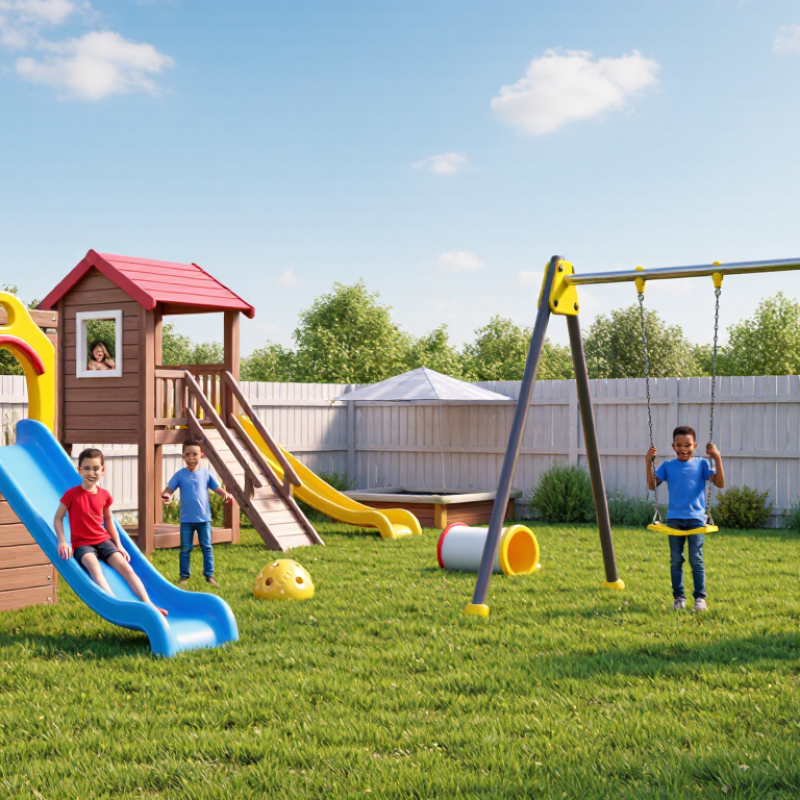
A playground set is a group of outdoor play structures, often including swings, slides, climbing frames, and platforms. These features invite children to move, explore, and invent games. A low platform can become a lookout; a rope ladder asks children to plan each step. The play is not always tidy. That is part of its value.
The World Health Organization’s 2020 physical activity guidelines recommend that children and adolescents aged 5–17 average at least 60 minutes of moderate-to-vigorous activity daily across the week. Playground sets can offer chances to build that movement into ordinary play, through climbing, swinging, and running between features. They also create moments for taking turns, negotiating rules, and testing confidence. Not every child will enjoy the same challenge, so varied heights and accessible routes matter.
Safety deserves equal attention. The U.S. Consumer Product Safety Commission reports that more than 200,000 children receive emergency-department treatment each year for playground-related injuries. A set cannot remove every risk. Caregivers should check for loose fasteners, worn swing seats, and hard or exposed ground, and supervise play according to children’s ages and abilities. A playground can look inviting and still need better upkeep.
A playground set is a group of play features designed for active or imaginative play, often arranged in a shared outdoor space. The options below illustrate common types, the play they encourage, and practical space considerations. Actual dimensions and age suitability vary by product and setting.
| Playground Set Type | Typical Features | How It Supports Play | Space Considerations | Practical Note |
|---|---|---|---|---|
| Swing set | One or more suspended seats attached to a frame or overhead beam | Encourages movement, balance, coordination, and turn-taking | Needs room for the frame and a clear area in front of and behind each swing | Choose seat styles suited to the children using it and follow the product’s installation and spacing instructions. |
| Slide set | A raised platform or ladder connected to a sloping slide | Supports climbing, spatial awareness, and repeated active play | Requires space at the ladder, platform, slide exit, and surrounding fall area | Use an appropriate protective surface and keep the slide exit clear. |
| Climbing dome | A dome-shaped frame made of connected bars or grips | Builds strength, coordination, route planning, and confidence through climbing | Needs clearance around the structure as well as a suitable landing surface | Check that openings and climbing elements are suitable for the intended age group. |
| Climbing frame or jungle gym | Combination of bars, ladders, and sometimes climbing panels | Offers varied ways to practise upper-body strength, balance, and problem-solving | Footprint depends on the number and arrangement of climbing features | Inspect connections and surfaces regularly, especially on frequently used equipment. |
| Play tower or fort | An elevated play platform with access steps or a ladder; may connect to a slide or bridge | Combines movement with pretend play, social interaction, and imaginative games | Allow for the platform, access route, any attached features, and clear fall space | Guardrails and access features should match the product’s intended age range. |
| Seesaw | A pivoting beam with seats or handles at opposite ends | Encourages cooperation, timing, balance, and shared movement | Needs room for movement at both ends and for children to get on and off safely | Adult guidance can help children coordinate turns and avoid sudden drops. |
| Spring rider | A small seat or shaped figure mounted on a large spring | Provides rocking movement and opportunities to practise balance and body control | Usually compact, but still needs clear space around the moving seat | Check the spring, anchor, and fasteners for wear as part of routine maintenance. |
| Sandbox or sand-play area | A contained area with loose sand and room for scoops, buckets, and moulds | Encourages sensory exploration, creativity, cooperative play, and early problem-solving | Can fit in a modest area; include room for children to sit and move around the edge | Keep sand clean and dry, and cover the area when it is not in use where appropriate. |
| Balance and stepping course | Low balance beams, stepping pods, or connected platforms | Supports balance, coordination, careful movement, and self-paced challenges | Can be arranged in a line or loop; leave space between elements for safe movement | Low elements can offer accessible challenges, but surfaces should remain stable and unobstructed. |
| Playhouse | A small enclosed or open-sided structure with doors, windows, or role-play details | Encourages pretend play, storytelling, social skills, and cooperative games | Needs room for the structure and clear access to entrances and exits | Look for ventilation, stable construction, and openings appropriate for the children using it. |
Planning reminder: Follow the equipment maker’s age, installation, clearance, and maintenance guidance. Provide suitable protective surfacing, keep play areas free of obstacles, and supervise children according to their age and abilities.