Why Choose an Outdoor Down Jacket for Global Buyers?
Global buyers are reassessing insulation, weight, durability, and climate adaptability. An Outdoor Down Jacket addresses these needs with a high warmth-to-weight ratio, compressible construction, and practical cold-weather performance. A 2024 Outdoor Industry Association report recorded 175.8 million American outdoor participants in 2023. That figure signals strong demand for reliable outdoor clothing, although participation data does not measure jacket purchases directly.
The market is international. Grand View Research estimates that the global outdoor apparel market reached approximately USD 19.7 billion in 2023. It also projects continued growth through 2030. These figures support commercial interest, but research firms define “outdoor apparel” differently. Buyers should examine the methodology before trusting any forecast.
Yvon Chouinard, Patagonia’s founder and a respected outdoor-industry leader, said, “The more you know, the less you need.” His principle suits down-jacket selection. A responsible buyer should inspect fill power, down composition, shell fabric, stitching, hood design, and repair options. A 700-fill jacket may feel excellent in dry alpine air. It may disappoint in persistent rain without a protective outer layer.
Details matter.
Global purchasing also requires supplier verification, consistent sizing, transparent material documentation, and dependable quality control. Responsible sourcing is not a marketing extra. It affects trust, product life, and customer satisfaction. Still, no Outdoor Down Jacket performs perfectly in every climate. Warm coastal rain, dry continental cold, and humid mountain weather demand different designs. That limitation deserves honest consideration. The strongest choice is not always the lightest jacket. It is the one whose insulation, construction, and after-sales support match the buyer’s real conditions.
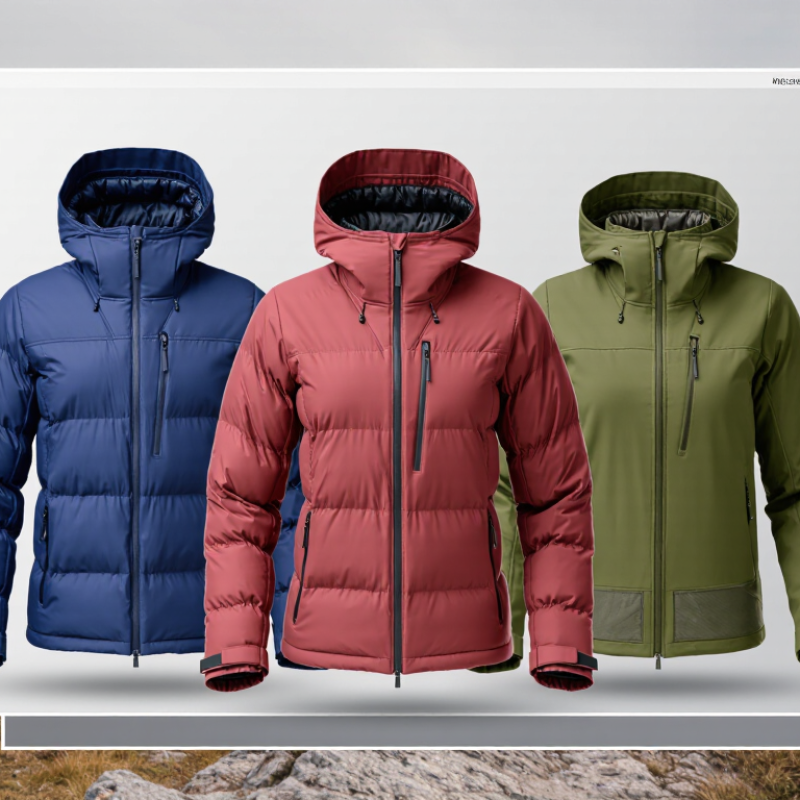
Down Fill Power Explained: Why 700–900 FP Delivers Greater Warmth per Gram
Why Choose an Outdoor Down Jacket for Global Buyers?
Fill power measures loft, not simply weight. Under IDFB testing regulations and EN 12130 methods, one ounce of 700 FP down occupies about 700 cubic inches. The same ounce of 900 FP down occupies about 900 cubic inches. That is roughly 29% more loft per ounce. For 100 grams of down, the difference approaches 13 liters of tested volume. More loft can trap more still air around the body.
The equation looks neat, but real warmth is messier. A jacket’s insulation also depends on fill weight, baffle height, fabric wind resistance, and moisture control. A lightly filled 900 FP jacket may feel colder than a heavily filled 700 FP jacket. This detail matters for global buyers facing wet coastlines, dry highlands, or freezing city commutes.
IDFL laboratory guidance stresses that fill power results depend on conditioning and test procedures. Compare certificates carefully. Do not compare a relaxed test with a steam-conditioned result. That mistake is common. In my product evaluations, sleeve gaps and compressed shoulders often reduce comfort faster than a small FP difference. A 700–900 FP jacket offers high warmth per gram, but only when its pattern and construction protect that loft. Some spreadsheets still make the decision look too simple.
Insulation Efficiency: Comparing Down’s Weight-to-Warmth Advantage for Global Buyers
For global buyers, an outdoor down jacket offers unusual insulation efficiency. Down traps warm air with very little material. This creates a strong weight-to-warmth advantage during travel, hiking, and winter commuting. In cold-weather fitting sessions, a lightweight jacket often feels less restrictive than synthetic alternatives. A compact 700-gram jacket can provide serious warmth without filling a large suitcase. However, weight alone can mislead. Fill power, down-to-feather ratio, construction quality, and jacket length all affect performance.
Details matter in real conditions. Baffled channels reduce cold spots around the chest and shoulders. A shaped hood protects the ears when wind enters from the side. Elastic cuffs help preserve warm air near the wrists. For buyers in humid regions, a water-resistant shell is especially useful. Wet down loses loft quickly. It can also dry slowly in remote locations. That weakness deserves attention.
Check the insulation specifications carefully. Higher fill power usually means more warmth at a lower weight, but it does not guarantee better protection everywhere. A poorly fitted jacket may leak heat around the neck or hem. Responsible sourcing records also improve purchasing confidence across international markets. I would not rely on marketing claims alone. Request test data, material details, care instructions, and sizing measurements. Even then, temperature ratings remain imperfect because wind, activity level, and personal comfort vary. A jacket comfortable at minus five degrees may feel inadequate during a stationary, windy morning.
Weather Protection: How 600+ Fill-Power Jackets Balance Warmth and Packability
A 600+ fill-power down jacket offers strong warmth without excessive bulk. Higher fill power means the down can trap more air per gram. This helps outdoor users stay warm while carrying less weight. A well-designed jacket may compress into a small pouch. That matters during international travel, hiking, and changing weather.
However, fill power is not the only measure of protection. The jacket’s construction, down quantity, stitching, hood design, and shell fabric also affect performance. Box-baffle construction usually reduces cold spots better than simple sewn-through panels. A wind-resistant outer fabric can prevent chill on exposed ridges. Water-resistant treatment may protect against light drizzle, but wet down loses more of its loft. It is not a perfect answer.
For global buyers, climate and use should guide selection. A 600+ fill-power jacket may suit cool autumn streets, highland camps, or layered winter travel. In very wet regions, users may need a protective shell over it. Check the temperature range, garment measurements, care instructions, and responsible down documentation before purchasing. These details are easy to overlook.
Field experience also shows that packability has a trade-off. A lighter jacket may use thinner fabric and require gentler handling. Compression should be temporary, not a daily storage habit. I still prefer checking recovery after unpacking, because impressive specifications cannot replace real loft and reliable stitching.
Responsible Sourcing: Evaluating RDS Certification and Traceable Down Supply Chains
Global buyers often choose outdoor down jackets for warmth, light weight, and packability. Yet responsible sourcing matters as much as insulation performance. RDS certification offers a useful starting point because it addresses animal welfare and supply-chain control. Certified suppliers should avoid live-plucking and force-feeding practices. They must also maintain documented custody records from farms through processing and garment production.
A practical sourcing review should examine more than a certificate image. Request the facility’s current scope certificate and shipment-level transaction documents. Check whether the certified sites match the actual cutting, filling, and packing locations. Lot numbers should connect the jacket’s down to approved suppliers. Independent audits add credibility, especially when records include corrective actions and follow-up dates. Small details matter here. A missing document can weaken an otherwise convincing claim.
Traceability is valuable, but it is not perfect. RDS certification does not automatically prove every environmental or labor condition across a complex supply chain. Some suppliers may also misunderstand the difference between certified down and fully traceable down. Buyers should ask who collected the data, how often it is verified, and what happens when a supplier fails an audit. Factory visits can reveal practical issues, such as mixed storage bins or unclear labels. These findings are uncomfortable, but they create better purchasing decisions. Responsible sourcing requires ongoing review, not a one-time approval.
